
ICG 2025
The 27th International Congress on Glass, themed “Glass: A Smart and Indispensable Material for Sustainable Society,” will be held from January 20th till January 24, 2025, in Kolkata, India.
Join SEFPRO at ICG 2025
Abstract 1: Glass Furnace corrosion monitoring supported by numerical simulation: A key solution to follow soldier block corrosion
The decarbonation of glass manufacturing has led glassmakers to significantly evolve glass melting processes. Among these developments, we are seeing the increasing use of electric melting to reduce gas consumption and CO2 emission. Nevertheless, the glass furnace electrification leads to a significant change in the operating conditions of soldier blocks. In particular, the temperature level and glass flow speed conditions near these blocks can induce accelerated corrosion, different corrosion profiles from those of traditionally observe in flame furnaces using low electrical power. By consequences, glass furnace lifetime could be affected and the strategy to manage it.
This is why, with the objective of better monitoring and anticipating these corrosion conditions, SEFPRO has jointly developed tank wear monitoring solution SEFPRO GUARD® as well as prediction tools with the support of numerical simulation.
We will discuss in detail, during the presentation, how SEFPRO GUARD® monitoring system works and how the interaction with corrosion calculations using the finite element model FEM makes it a powerful tool to follow corrosion and lifetime. Data treatment, through our SEFPRO GUARD® interface make also possible to implement alert system for short term reaction.
We will take opportunity to disclose parametric corrosion studies based on our numerical simulation model, using different running conditions for high electrical boosting furnaces. It can be correlated to long term temperature evolution measure by the monitoring system. Finally, will share the results we obtained with SEFPRO GUARD® solution on an industrial furnace and show, how a deep temperature analysis evolution, coupled with simulation is able to estimate tank furnace wearing and lifetime.


Abstract 2: Advanced Refractory Solutions for low CO2 emission glass melting process
Glass industry is highly committed to decrease CO2 emission of glass manufacturing in order to follow the path of Greenhouse Gas Emission reduction decided through international climate change agreements, to face established or coming ETS regulation and to satisfy their customer sustainability roadmap.
Significant part of Glass manufacturing CO2 emissions are linked to melting process and we can observe various melting technology evolutions to decrease fossil fuel consumption depending on furnace geographic location, alternative renewable energy sources availability, energy cost, safety management ….
Among these melting process changes, we can observe increasing use of electrical energy in high electrical boosting glass furnace, hybrid furnace up to full electrical furnace. Alternative fuels such as renewable biofuel, hydrogen are also applied in glass furnace, with more limited application time, trough development tests. Increasing use of glass cullet can also be mentioned here.
It creates real new challenges for refractory material either for superstructure application or glass contact. We will review the impact of these glass melting technology evolution on refractory running conditions and discover, how SEFPRO has designed Fused Cast advanced refractory solution to face these new challenges.
With SEFPRO long experience on refractory behavior and deep knowledge on running condition analysis, we have developed application tests in our research center SGR Provence, to be as close as possible to these new glass melting processes.
We will discuss during the presentation application test results and take the opportunity to present new fused cast refractory material, their properties and performances in comparison to well-known references.


Abstract 3: Industry 4.0+: Enhancing Production Efficiency with AI and MPC, Reducing Carbon Footprint, and Asset Monitoring
Glass Service (GS), has been installing Expert Systems & Model based Predictive Control (MPC) software to Supervisory control glass melting furnaces and forehearths over 24 years. Since 2010 this has been boosted by the The Industrial Revolution 4.0 (4th IR) that demands further networking and automation of the production process.
Since 2020 started the next era of Disruptive technologies. We believe that steam (1st IR), electricity (2nd IR), computers (3rd IR) and networks connecting sensors and computers (4th IR) changed our society a lot. But the new technologies such as Artificial Intelligence (AI), Neural Networks (NN) are total Disruptive beyond what we have seen till now.
In recent years we have been adding ultra high definition (UHD) cameras with near infra-red (NIR) capabilities to produce an automatic batch analysis and artificial Intelligence (AI) smart software to interpret the batch coverage while also giving complete furnace interior temperature mapping. The batch coverage is modeled together with the other multi-input and multi-output process variables which can become a more thorough control option to increase the furnace stability and improve glass quality. In total already more than 400 glass furnaces worldwide are using this technology.
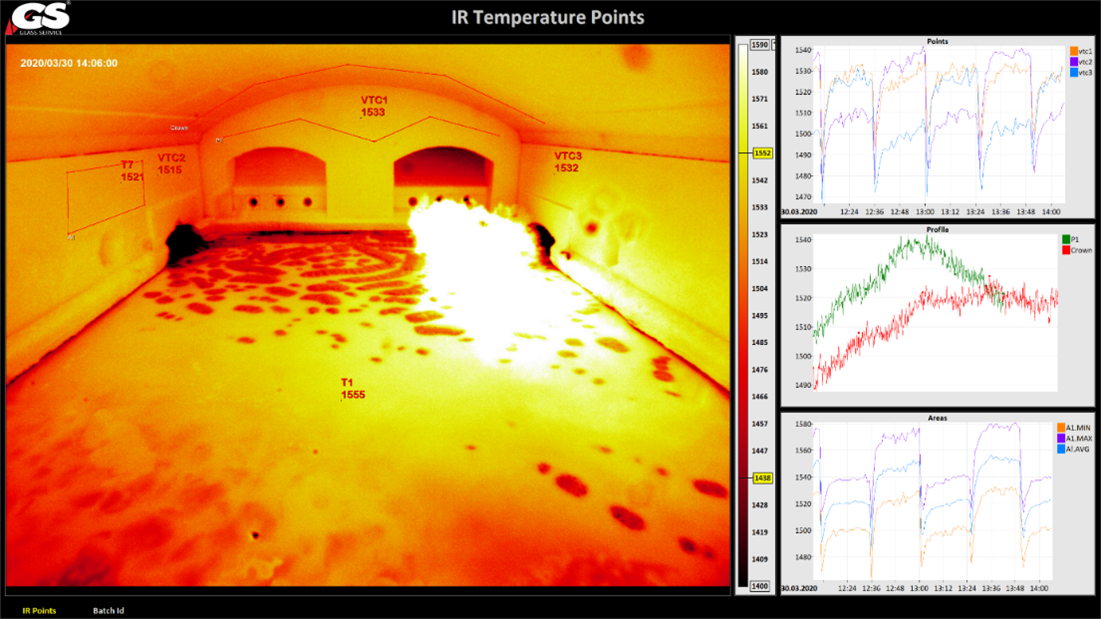
The paper will present new results in what this can bring to Glass Production. We will show practical examples how MPC & AI are able to improve the production efficiency of glass production in terms of improved yield and energy savings. Benefits can be 3-4% energy cost savings while reducing variations and defect levels with less operator attention needed. Yield improvements can be 1-2% and this benefit is even more value than the energy reduction. All together it will help to reduce your carbon foot print as increasing the production yield with reduced operator intervention means you can sell more tons of glass while using less energy.
We also will outline some new plans how GS Expert System not only can optimize the process but also protect the asset life time.

Abstract 4: Mathematical modelling as a “must” in sustainable glass production
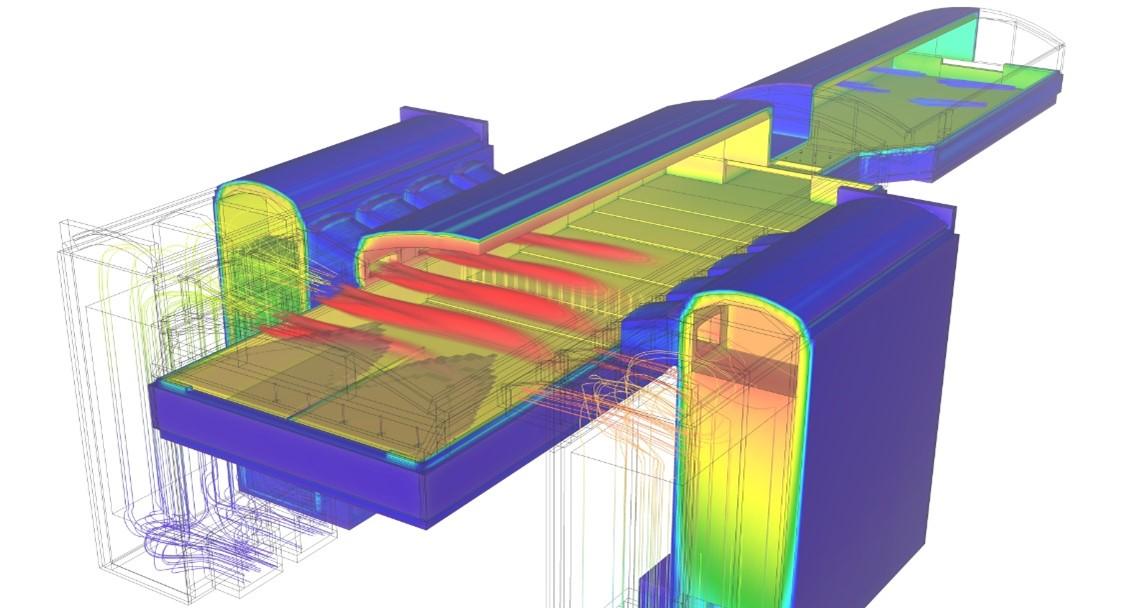
Nowadays, any bigger design change of glass furnace without help of mathematical modelling would be a pointless risk. The still increasing power of computers creates a huge opportunity for use of CFD modelling that helps to understand the processes within the furnace. Furthermore, the price of computing power is still decreasing. Therefore, the cost of any modelling study is incomparably low to the costs of any repair that would be needed after unsuccessful trial-error experiment. Another very important benefit is the speed of modelling – the first results of planned changes could be evaluated in few days or weeks (and again with no risk to real production).
Frequently and repeatedly discussed target of any production (glass production as well) in these days is its sustainability. The question is, how to reach it? Is it simply the switch to more advanced fuels? Or complete redesign of the furnace? Going all electric or hybrid? With answering all these questions (and much more) the mathematical modelling could help.
Glass Service (GS) has internally developed a software (Glass Furnace Model - GFM) that is aimed at the usage in glass melting industry. It is regularly updated to give the customers as many benefits from modelling as possible. Many customers use GFM on daily basis, other order just the modelling studies directly from GS. The positive feedback from the customers is the leading motivation for us to go on.
A brief description of Glass Service’s modelling study workflow would be presented in the lecture together with the latest features available in the GFM.
For better understanding of how the modelling study could look like, a few examples from real problems would be shown (with respect to confidentiality of customer’s data).

Abstract 5: Understanding the Effects of Batch Coverage on the Industrial Glass Melting Process
Industrial glass melting is a complex and intricate process that relies on the careful orchestration of various input parameters to ensure optimal process stability and glass quality. Already, slight changes in known disturbances like pull rate, batch chemistry, cullet ratio, or cullet size distribution can bring the process out of balance, causing production problems and defects. Therefore, furnace operators must observe and control the melting process 24/7 to avoid expensive production losses.
Batch coverage is, among other things, sensitive to variations in the batch composition and moisture. Therefore, observing and analyzing the batch distribution and utilizing this information for advanced furnace control helps stabilize the melting process. To this end, Glass Service has developed batch monitoring systems to analyze the batch melting behavior inside combustion as well as cold-top furnaces.
A high-resolution near-infrared camera monitors temperatures and batch island movement in combustion furnaces. In combination with the model predictive control of Glass Service’s Expert System III (ES III™), unfavorable batch formations (e.g., snakes) that lead to an increase in glass defects can be avoided.
A critical parameter for the successful control of cold-top vertical melters is the knowledge of the batch height. Therefore, Glass Service supplies batch blanket monitoring systems for cold-top furnaces. The system comprises a contactless batch height measuring system and a near-infrared camera. The batch height sensors give reliable information about the batch coverage that is needed to control the furnace with ES III™. Information about the batch height is crucial for the control because it affects the heat losses of the furnace. The camera system assists operators in seeing inconsistent batch coverage so that the batch feeders can be focused on these parts.
